Fraud Intelligence Blockchain — Q2 2026 Quarterly Report
Sun Aug 09 2026
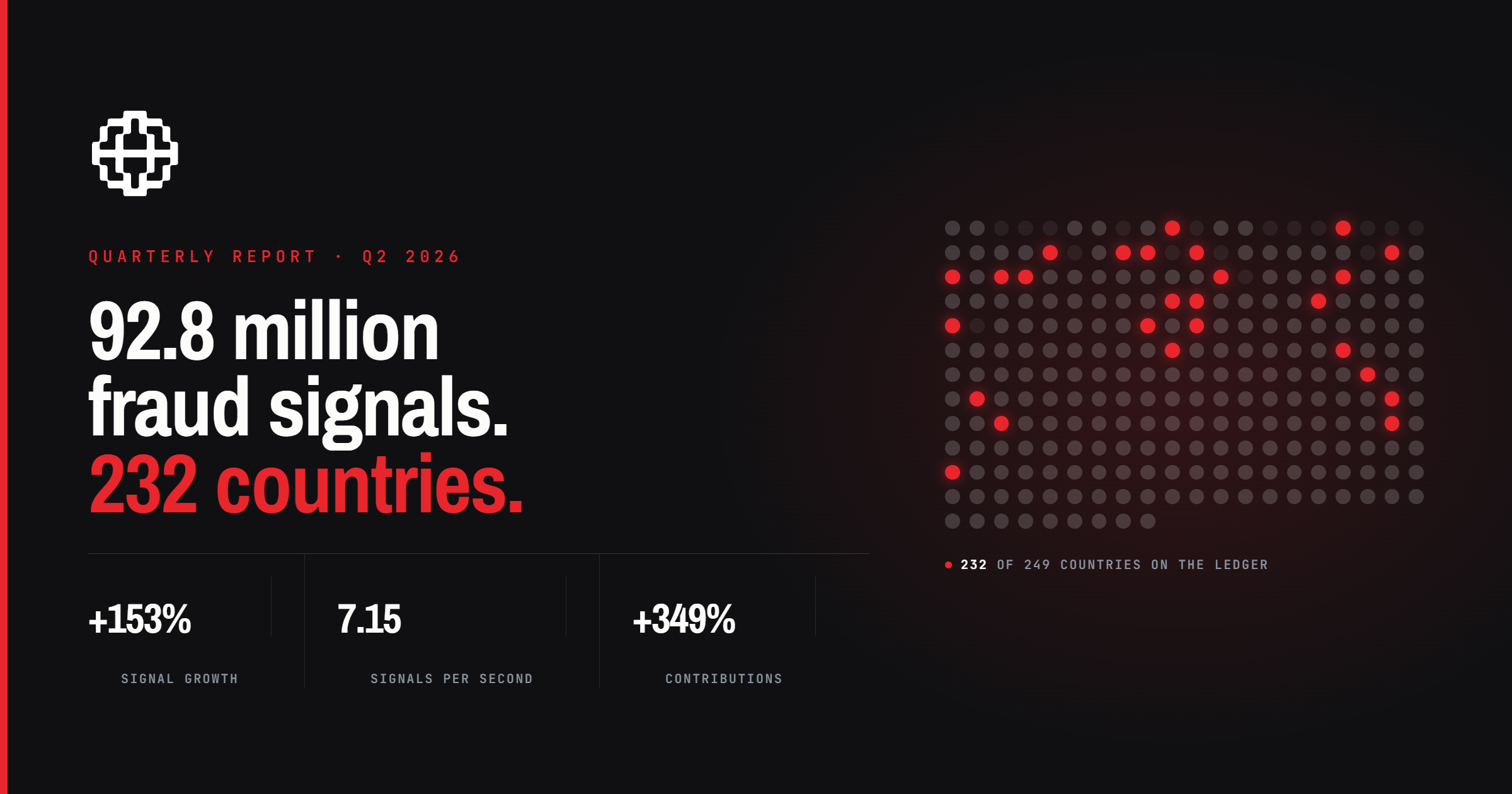
92.8 million fraud signals. 232 countries. One quarter.
August 2026
Dear FIB Network member,
Our Q2 2026 report covers the three months to 30 June. In that time the Fraud Intelligence Blockchain more than doubled, member contributions rose 349%, and sixteen new countries appeared on the ledger for the first time.
Report Highlights
- 92.8M fraud signals on the ledger, up from 36.6M
- Intelligence spanning 232 of 249 ISO country codes
- 7.15 fraud signals per second, up from 2.96 in Q1
- +349% QoQ increase in member contributions
- Sixteen new countries added in Q2, none lost
- Coverage: Flash Calling, Scam Calls and Texts, Wangiri, IRSF, IP Fraud
The headline number is 92.8 million. That is the total count of verified fraud signals now held on the Fraud Intelligence Blockchain, up from 36.6 million three months earlier. Q2 alone added more than the entire ledger held at the close of 2025.
Growth came from breadth rather than bulk. Contributions rose 349% against a 144% rise in signals, which means more members contributing more often rather than a handful of large submissions inflating the total. Every fraud type on the ledger grew in absolute terms.
Q2 alone added more fraud signals than the entire ledger held at the close of 2025.
What the quarter showed
Fraud is dispersing, not concentrating. Forty countries now account for 90% of contributions, against thirty-one two quarters ago. The base is broadening, which makes blocking by geography a blunter instrument each quarter.
Coverage now stands at 232 of the 249 ISO country codes. Sixteen countries were added in Q2 and none were lost. Almost every new entry is a small island or territory number range — the asset class one-ring and premium rate fraud are built to monetise.
Intelligence moved faster. Signals reached the ledger at 7.15 per second, up from 2.96 in Q1 and 0.17 two quarters ago. At that rate an identifier surfaced by one member is available to every other member before most operators could complete an internal escalation.
Flash calling accounted for three quarters of everything contributed. It was recorded in 227 of the 232 active countries and on all 91 days of the quarter. In 45 of those countries it makes up more than nine in ten fraud records.
Why connection data matters
Fraud is fought across three kinds of signal: connection, identity and transaction. Identity signals appear at sign-up, transaction signals at payment. By the time either exists, the fraudster is already inside the funnel.
Connection signals — the call, the message, the routing — sit with telecoms operators and are observable before a customer has been contacted, an account opened or a payment attempted. That interval is the whole opportunity to prevent fraud rather than detect it after the fact.
Connection signals arrive before a customer has been contacted, an account opened or a payment attempted. That interval is the whole opportunity.
The catch is that no single operator sees enough alone. Flash calling turned up in 227 countries this quarter. Any one network sees a fraction of that, and a fraction is not enough to recognise a pattern before it lands. Static reference data — numbering plans, IP registries, route objects — tells you what an asset is. It says nothing about whether that asset is being abused today.
That gap is what the consortium closes. Each member contributes what it observes and retrieves what every other member has observed, verified and attributed on the ledger.
Interactive Report
The full quarterly report covers all five fraud types in detail, with origin country breakdowns, velocity analysis and the coverage picture across every country on the ledger.
Open the report in a new tab →
Download the full report (PowerPoint) →
Talk to us about joining the consortium →
Please register or log in today to learn more about Fraud Intelligence Blockchain.
FIL GitHub: https://github.com/fraud-intelligence-limited
FIL API: https://fraud-intelligence-limited.github.io
About Fraud Intelligence Limited
FIL, based in the United Kingdom, is at the forefront of blockchain-based fraud detection technologies, driving global innovation and providing top-tier solutions to combat telecom fraud effectively.