Follow the Number, Part 2
The Life of a Number
The life of a number
Fraud numbers are not picked on the day of an attack. They have a life, and most of it is lived quietly, in public, long before anyone is harmed. Here is 1186's.
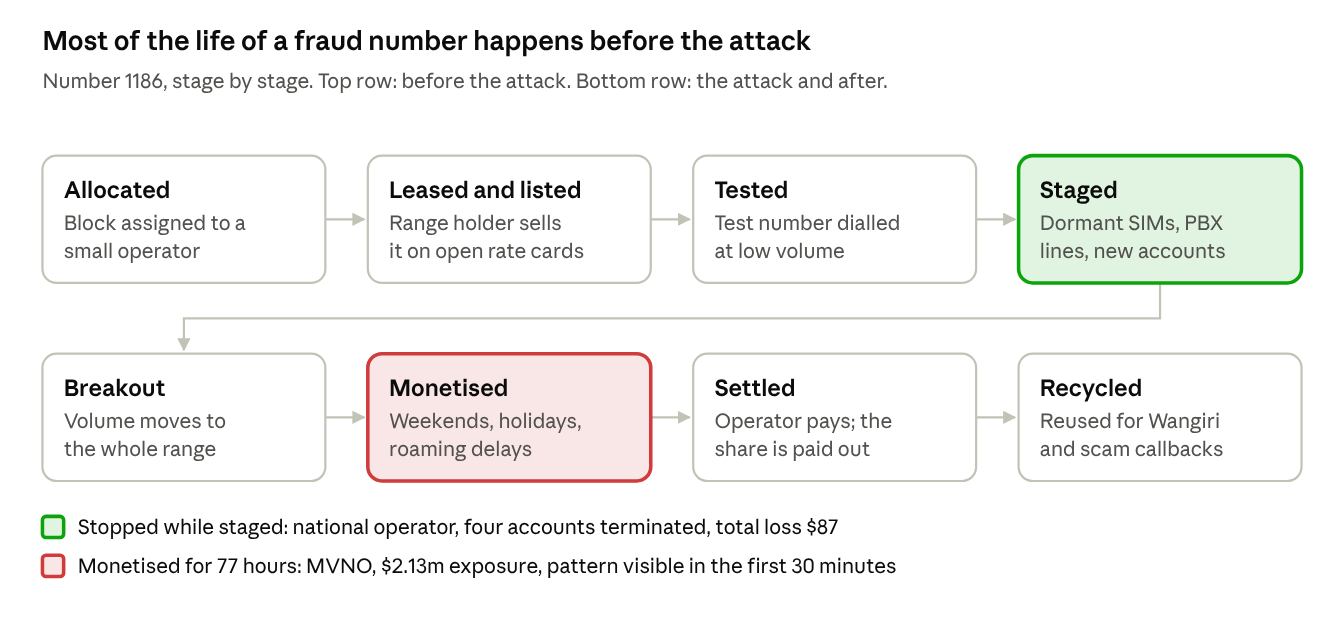
For a while, 1186 is just inventory. Then a range holder secures a revenue share deal on its block and puts the block up for sale. Sellers of this inventory advertise openly. Rate cards are listed by destination, price changes are announced to buyers, and some sellers offer volume incentives that raise the revenue share as traffic grows. It behaves like any commercial market, with price lists and customer support, and supply follows demand.
A buyer will not waste stolen access on a route that might not pay, so they test it first. Sellers often publish test numbers for exactly this purpose, and for a time 1186 is that number. Buyers dial it, or message it, a handful of times. The calls are short and the volumes tiny. Their only purpose is to confirm that the route is live and that revenue will follow. This is the first moment 1186 becomes visible to anyone watching the supply side. On most networks, nobody is looking that closely.
Once the route is proven, things go quiet. The buyer gathers access: dormant or freshly activated accounts with almost no usage, business lines with trunk access, PBX access illicitly gained but not yet exploited. Nothing much happens on any network. The quiet is the point.
Then the range breaks out, and here is the detail that catches most operators out. The attack does not run through 1186. It runs through the numbers around it. A test number exists to prove the route, not to carry traffic, so it rarely does. In one provider's international traffic, across more than 170 destination countries, exact matches to known test numbers made up no more than 0.8% of the traffic. Counting the ranges already tied to those operations took that to roughly two thirds. An operator that blocks 1186 and closes the case has blocked the one number the fraudster no longer needs.
Monetisation takes two shapes. The first is the short, sharp hit, timed for when people are not watching: a weekend, a public holiday, a roaming route where records take longer to process. This is where the MVNO’s 77 hours belong. The second is slower and harder to see. Traffic is held at fairly ordinary volumes while hijacked routes are switched on and off, so that no single threshold is clearly crossed and the controls in place cannot tell what normal looks like. Either way, the settlement cycle runs weeks later and the originating operator pays. By the time anyone queries the invoice, the fraudster’s share has often been paid out and moved on.
And then 1186 is recycled. A few operators block its range; most forget it. A fraudster who holds a range can move between schemes as the money shifts, which helps explain why investigators working on Wangiri missed-call scams so often land on numbers already linked to IRSF. We pick up 1186 there in Part Two.
Two operators, two endings
Where you meet the lifecycle decides what it costs you. Two real cases make the point better than any model could.
The first is a national operator. A review of dialled numbers against curated intelligence showed an 86% match to known high-risk numbers across four business accounts with PBX and trunk access. Neither the match nor the way the accounts had been set up was conclusive alone. Together they were enough to act on, and further checks showed all four had been opened with fraudulent applications. The accounts were closed while the operation was still being staged. Total loss: $87.
The second is the MVNO. Similar numbers, very different outcome. The MVNO only met the lifecycle at its far end, facing a $2.13 million settlement exposure, and a check run after the event showed the pattern had been visible within 30 minutes of the calls starting. What separated the two cases was whether the operator had that intelligence in front of someone able to act on it. Part Two is about that difference.
Where the money goes
Most fraud leaves a criminal holding stolen money that still has to be cleaned. IRSF does not. Its proceeds arrive through the settlement chain itself: a wholesale payment between licensed carriers, under contract, backed by an invoice. By the time the money reaches the range holder it looks like any other termination revenue, because on paper that is exactly what it is.
In our assessment, the settlement system does the first stage of laundering for free, which is part of what draws organised crime to the trade. US law enforcement has described cyber-enabled fraud as a blended threat, where organised crime groups, affiliate schemes, state-linked actors and countries with weak enforcement overlap. For these groups, telecoms can be more than a route to victims. The settlement chain can also earn money directly and move value across borders.
Pinning responsibility on any single party is difficult, and the layering is part of the design: ranges pass through several intermediaries, which obscures who benefits. A common arrangement is a route whose paperwork looks ordinary while the high-risk numbers arrive through another relationship altogether. The normal traffic keeps the partner looking familiar, and the risky inventory is handled elsewhere. Route history, partner behaviour and number intelligence therefore need to be reviewed as one body of evidence.
The cost beyond the bill
The settlement bill is the part of IRSF that gets counted. It is rarely the largest part.
“One business case I reviewed was for a new direct satellite link into a specific country. When we analysed the paid traffic that route was carrying, something like 95% of it was unpaid. The business had built serious infrastructure to serve a demand signal that fraud had almost entirely generated. Nobody signs off a capital case like that on purpose. It happens because the demand data feeding the decision was never checked against fraud intelligence.”
The rest of the cost is scattered across other people's budgets, which is why it so rarely gets added up. Fraud traffic, generated or diverted, fills network capacity exactly like real traffic, so planning and peering decisions get made against demand that fraud has shaped. Customers caught by a hacked PBX or a hijacked account feel it directly, and customers blocked by a blunt control feel it too. Neither shows up as fraud. Both show up, eventually, as churn.
Settlement disputes can be won on paper, but they take time and evidence, and they strain partner relationships you still need. Each investigation that could have been avoided also takes a fraud, routing or wholesale team away from other work.
The industry's own headline figure has the same blind spot. Between the CFCA's 2023 and 2025 surveys, fraud losses as a share of revenue fell slightly, from 2.50% to 2.46%. Absolute losses rose by $2.87 billion, to $41.82 billion. A board reading the ratio sees progress. A board reading the dollar figure sees the opposite. Both are looking at the same data.
Why one operator sees so little
Look back at Number 1186's life and notice where each stage happened. The rate card was public. The test calls ran across other networks. The neighbouring numbers in its range were being dialled from elsewhere long before any traffic reached the operator that eventually paid. Almost everything that predicted the attack happened outside that operator's perimeter.
“Any enterprise that claims it has sufficient fraud intelligence is operating inside a silo. They only see what hits their own network perimeter, but the industrial fraud economy operates almost entirely in the spaces outside it.”

That is why the range, and the operation behind it, is a more useful unit of intelligence than any single number. A known number points to something larger: related ranges, routes, suppliers and accounts. Used as a starting point rather than a stopping point, one match can bring dormant accounts and ranges into view before they become active, so that a single signal leads to many cases being headed off.
Intelligence of this kind is built from the supply side: who is selling, what they are selling, which ranges belong together and how long they stay live. It depends on specialist sourcing and steady upkeep, including retiring ranges that have gone quiet to keep false alarms down. That is a different discipline from analysing your own call records, and it adds to internal detection without replacing it.
Questions only your own data can answer
We could model what this costs a typical operator, but without your own data any figure would be a guess. Here are six questions worth putting to your own team instead.
- When a known high-risk number appears in your traffic, does anyone check the range around it, or does the case close with the block?
- Are your fraud cases recorded by motive as well as method? Could you say how many of last year's SIM farm or PBX cases ended in a revenue share payout?
- Does your least cost routing weigh route provenance and fraud history alongside price?
- Does a country-level allow-list ever take precedence over number-level intelligence in your controls? Fraud destinations move with routing opportunities and available inventory, so a broad exception can undermine a much more targeted control.
- Who can act on a high-risk signal at nine on a Friday night, and how long does it take them?
- Do any of your own number ranges appear in fraud intelligence? If so, how much traffic that should have terminated on your network is being settled elsewhere?
Where Number 1186 goes next
A few months after the attack, Number 1186 turns up again. This time nobody dials it by accident or by machine. It sits in a text message that claims to come from a customer's bank, as the number to call back.
That is the point at which a telecoms fraud problem stops being only a telecoms problem. Banks, payment platforms and government services now treat the mobile number as part of a person's identity, and the evidence suggests fraud that starts on telecoms networks lands harder. UK Finance's Annual Fraud Report 2026 found that 17% of authorised push payment scam cases in 2025 began via telecoms, but those cases accounted for 28% of losses. Regulators are following the trail: Australia's Scams Prevention Framework now places enforceable duties on telecoms providers alongside banks and digital platforms.
Now picture a different version of this story. The operator sees 1186 the week it is being tested, on someone else's network. It checks the range, not just the number. It spots the dormant accounts lining up behind that range and closes them on a Tuesday afternoon, not after a long weekend. The loss is counted in a few dollars, not in a quarter's margin, and nobody outside the fraud team ever hears about it.
None of that needs technology that does not exist today. So why does it happen so rarely? Part Two asks why, with so much of a fraud number's life visible in advance, the industry still mostly learns about it from the invoice. Part Three follows 1186 out of telecoms altogether, into the identity checks the rest of the digital economy depends on.

About Fraud Intelligence Limited
Fraud Intelligence Limited (FIL) is the AI-powered data intelligence layer for cross-sector fraud prevention. Leveraging AI to enhance GDPR compliant threat signals from over 50 global telco networks into an explainable, real-time Fraud Reputation Score via API, FIL serves as a primary intelligence feed for enterprise risk engines, financial institutions, and investigative platforms. To learn more, visit fraudintelligencelimited.com.

About Symmetry Solutions
Symmetry Solutions is an independent telecoms specialist that has helped operators and partners improve operational performance, protect revenue and strengthen governance since 2009. Its work spans business assurance, fraud management, data integrity and complex change. Its Shield service, in continuous operation since 2013, provides curated IRSF and high-risk number intelligence across voice and messaging, used well beyond blocking to protect customers and revenue, and delivered by API and portal into routing, screening and fraud management workflows.
Sources
- CFCA, Global Fraud Loss Survey 2025: total losses, loss ratio, IRSF/AIT and spoofing figures, fraud and bad debt reporting.
- ITU, Universal International Premium Rate Numbers, ITU-T Recommendation E.155.
- Commsrisk, Elon Musk says Twitter lost $60mn a year because 390 telcos used bot accounts to pump A2P SMS, 12 January 2023; X, An update on two-factor authentication using SMS on Twitter, 15 February 2023.
- US Department of Justice, readout of Deputy Attorney General Lisa O. Monaco's remarks on the blended threat, 1 July 2022; FBI, Bryan Vorndran, remarks at the 2024 Boston Conference on Cyber Security.
- UK Finance, Annual Fraud Report 2026, press release: https://www.ukfinance.org.uk/news-and-insight/press-release/fraud-report-2026-press-release.
- ASIC, Scams Prevention Framework.
- Case studies and traffic analysis: casework by the authors. Client names withheld.